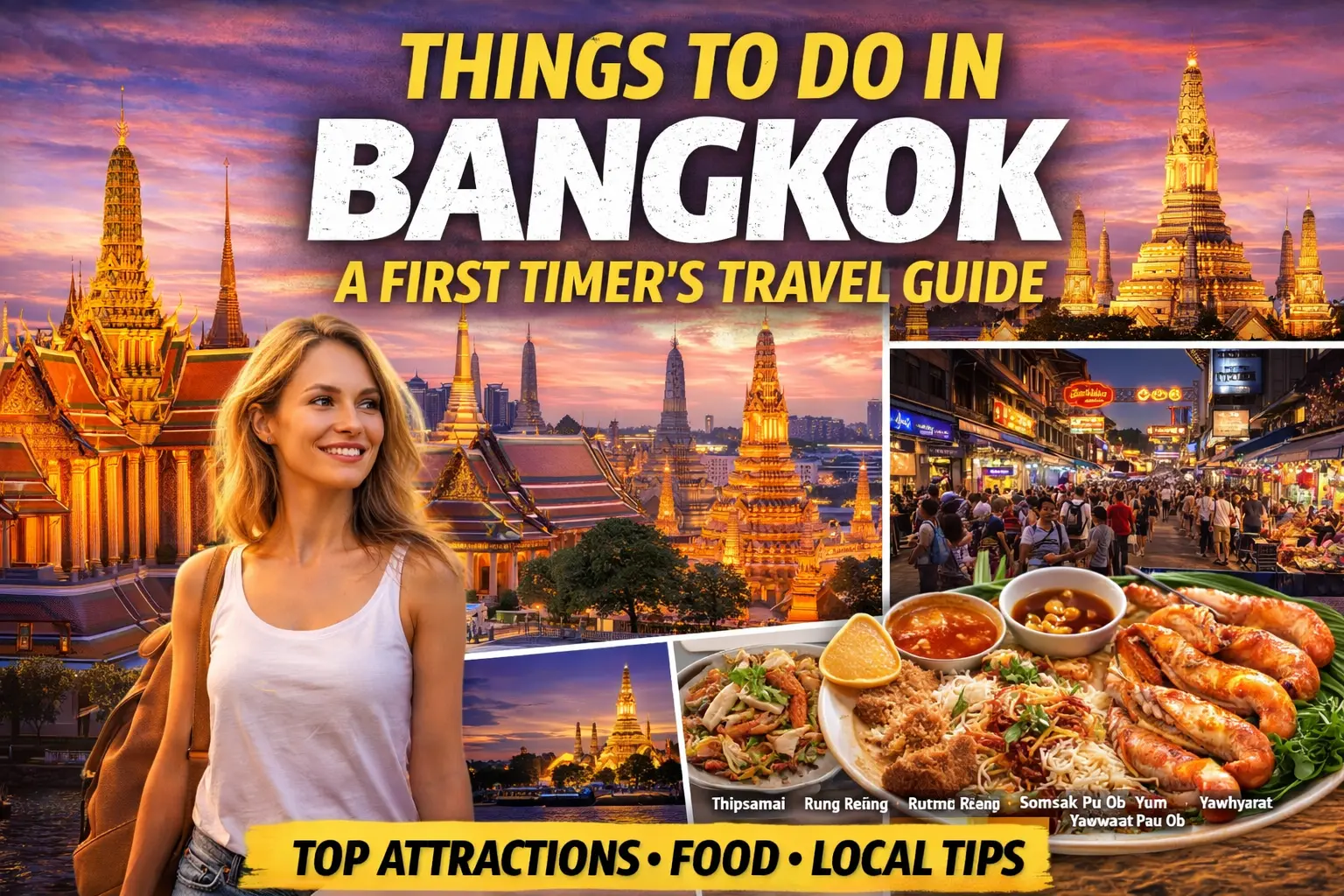
Quick Answer: The Must-Do Experiences In Bangkok
If you’re short on time and just want the highlights, here’s your at-a-glance list. Every section below expands on these, but this gives you the quick version before diving in.
Grand Palace & Wat Phra Kaew – Bangkok’s most iconic royal complex, home to the sacred Emerald Buddha
Wat Pho – The giant reclining buddha and birthplace of traditional Thai massage
Wat Arun at sunset – Cross the Chao Phraya River for golden-hour views of the porcelain-covered spire
Khao San Road at night – Backpacker chaos, neon lights, and late-night street food stalls
Chao Phraya river boat ride – See temples and the skyline from the water for just a few baht
Rooftop bar for sunset – Sky Bar at Lebua, Octave, or Tichuca for panoramic city views
Chinatown night street food – Yaowarat Road after dark is one of the best food experiences in Southeast Asia
Chatuchak Weekend Market – Thousands of stalls selling everything from vintage clothes to Thai art
Thai massage – Affordable, authentic, and the perfect way to recover after walking all day
A mall like Iconsiam or Terminal 21 – Air conditioning, fantastic restaurants, and a window into local life
Two to three full days is enough to cover most of this list. But if you can stretch to four or five days, you’ll have time to slow down, wander neighborhoods, and maybe add a day trip to Ayutthaya or a floating market.
Stop – Quick Reality Check Before You Plan Your Bangkok Trip
If you're traveling to Bangkok, Thailand from Europe, the U.K., the U.S., Australia or anywhere abroad, get your mobile data sorted before you land. This isn’t optional — it’s essential. 🌏📱
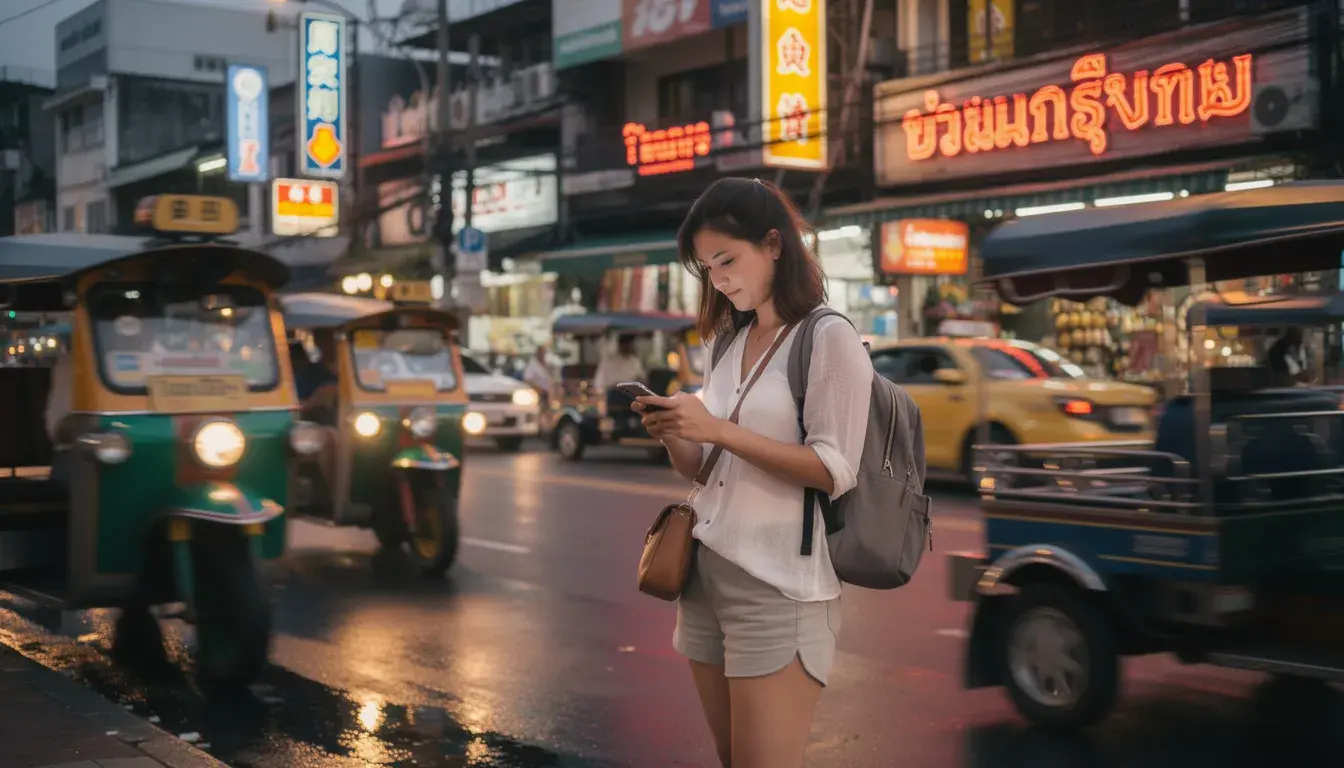
In Bangkok, you’ll rely on your phone constantly. From navigating the BTS Skytrain and Grab rides to translating menus at street markets and finding your hotel in Sukhumvit’s busy streets — you need fast, reliable data. Public Wi-Fi is inconsistent, café connections can be slow, and airport SIM kiosks often charge inflated tourist prices.
The smart move? Install an eSIM before your flight — and use a guide to choosing the best eSIM for travelers to compare plans and coverage before you buy.
With Roambit.io, you can get 20GB of high-speed data for just $14.99, ready to activate the moment you land. No physical SIM, no queues, no stress. ✈️
Trust me — when you're standing outside the Grand Palace trying to navigate to your next stop or calling a ride in the Bangkok heat, your future self will thank you. 🌴📍
Save 10% on Your Roambit.io eSIM – Use Code: EMMA10
Where to Stay in Bangkok 🏨
When choosing accommodation in Bangkok, it’s best to stay close to a BTS Skytrain or MRT station so you can move around the city easily. Traffic can be heavy, so having quick access to public transport makes a big difference. Personally, I often prefer staying around the Siam area because it’s central and very convenient.
Budget / Hostels:
For travelers on a budget, Bed Block One Hostel (around $16 USD per night) is a great option. It’s within walking distance of Ratchathewi BTS and not far from the airport rail link, making it easy to get around Bangkok.
Mid-Range Hotels:
S33 Compact Sukhumvit (about $55 USD per night) is located in Sukhumvit, close to the BTS and near the lively Thong Lor area, which has plenty of restaurants and cafés.
Another reliable option is Holiday Inn Express Siam (around $88 USD per night) near National Stadium BTS. It’s a convenient location with clean rooms, breakfast included, and even a small fitness center.
Luxury Hotels: ✨
If you want something more upscale, VIE Hotel Bangkok (around $188 USD per night) offers stylish rooms and a central location near the train lines.
For a premium stay, Chatrium Grand Bangkok (about $215 USD per night) provides modern facilities and a comfortable, high-end experience in the heart of the city.
Bangkok’s Big Temples & Royal Sights
Most first-time visitors spend at least one full day around the historic Rattanakosin Island area. This is where you’ll find the Grand Palace, Wat Pho, and easy access to Wat Arun across the river. It’s the spiritual and historical heart of Bangkok.
Dress code matters here. All major temples require covered shoulders and covered knees—no tank tops, no shorts, no ripped jeans. Thin scarves and sarongs are available for rent or purchase near temple grounds if you forget, but it’s easier to just dress appropriately from the start. Closed shoes are preferred but not always enforced.
Logistics tip: Arrive by boat or taxi early in the morning, around 8:30-9:00 AM. You’ll beat both the worst of the heat and the tour bus crowds that pile in by mid-morning. The Grand Palace, Wat Phra Kaew, and Wat Pho can comfortably fill a morning, with Wat Arun added by crossing the river in the afternoon.
Note that all prices listed are approximate and from the 2020s. Double-check current rates before your trip.
The Grand Palace & Wat Phra Kaew (Temple Of The Emerald Buddha)
The Grand Palace is Bangkok’s most important royal complex, founded in 1782 when King Rama I established the city as Thailand’s capital. Within its walls sits Wat Phra Kaew, home to the tiny but deeply sacred Emerald Buddha—a 66cm jade statue that serves as Thailand’s most revered religious object.
Detail | Information |
|---|---|
Entrance fee | Around 500 THB (~$15 USD) |
Opening hours | Approximately 08:30–15:30 daily |
Time needed | 1.5–2 hours |
Dress code | Long pants/skirts, covered shoulders, no ripped jeans |
The complex spans 94.5 hectares with over 100 buildings mixing Thai, European, and Chinese architecture. Beyond the Emerald Buddha hall, explore the gilded chedis, the detailed murals depicting the Ramayana around the cloister, and the more European-style royal reception halls.
Arrive as close to opening as possible. By 10:30 AM, the temple grounds can feel uncomfortably crowded, and the midday heat makes the experience far less enjoyable.
Wat Pho – The Reclining Buddha & Traditional Thai Massage
Just south of the Grand Palace, Wat Pho is one of Bangkok’s oldest and largest temples. It’s famous for its massive 46-metre reclining Buddha—a gold-leafed figure from 1793 with mother-of-pearl feet depicting 108 auspicious scenes.
Detail | Information |
|---|---|
Entrance fee | Around 300 THB |
Opening hours | Approximately 08:00–18:30 |
Highlights | Giant reclining Buddha, traditional Thai massage school |
Wat Pho is also the birthplace of traditional Thai massage. The temple houses Thailand’s original massage school, and the official massage pavilions on the grounds offer authentic sessions at posted prices. A 30-minute Thai massage starts around 280 THB. It’s a great way to rest tired feet after a morning of temple walking.
You can easily combine the Grand Palace and Wat Pho in a single morning, with a coffee or food break at one of the small cafés nearby.
Wat Arun – Temple Of Dawn On The Chao Phraya River
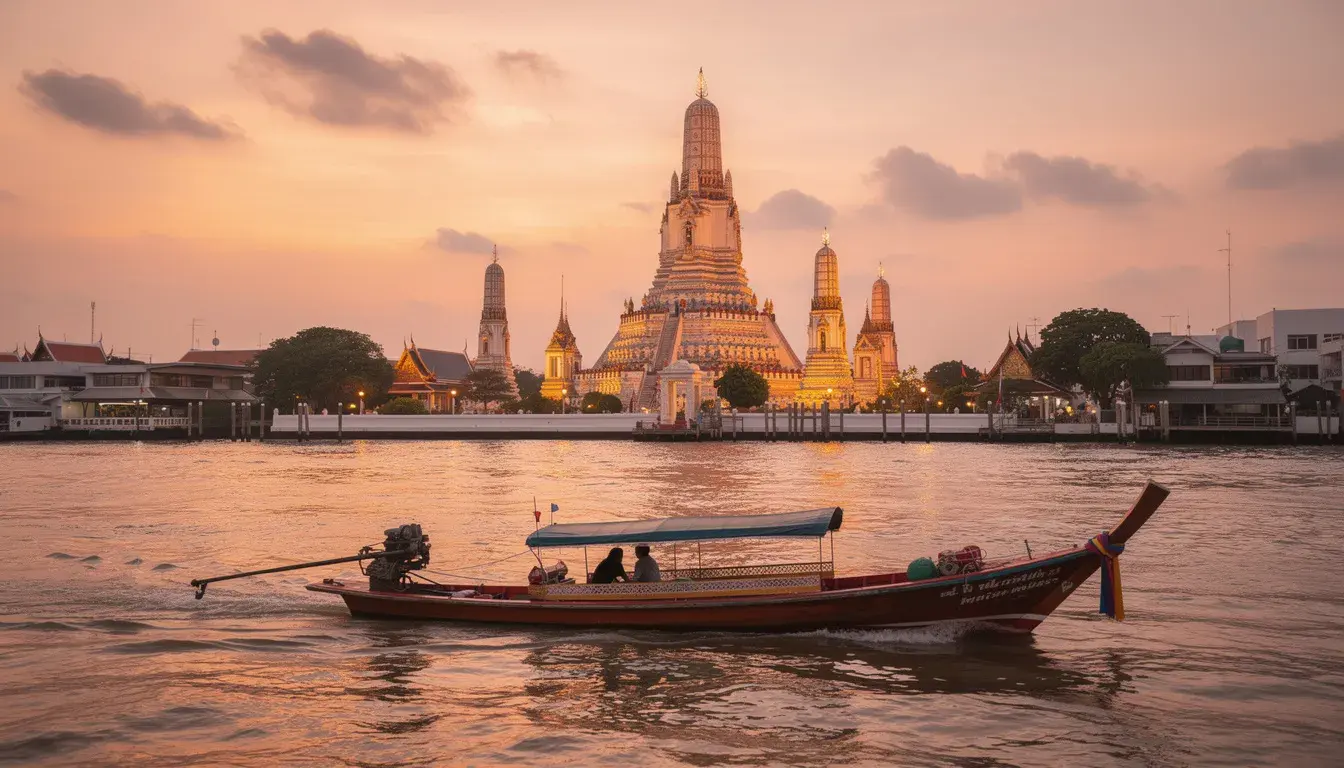
Wat Arun is the riverside temple you’ve seen on postcards and Thai coins. Its 104-metre central prang (tower) is covered in intricate porcelain tiles—actually recycled from Chinese boat shards—depicting scenes from the Ramayana.
Detail | Information |
|---|---|
Entrance fee | Around 200 THB |
Location | Thonburi (west) bank, opposite Wat Pho |
Best time to visit | Late afternoon for sunset |
Visit in the late afternoon when the light softens. After exploring the temple grounds, stay near the river to watch Wat Arun light up at sunset. You can catch this view from the temple itself or from one of the riverside cafés and restaurants on the opposite bank.
The stairs on the prang are steep, so be prepared if you want to climb partway up. The same modest dress code applies—covered shoulders and knees.
Other Notable Temples In Central Bangkok
If you want to explore beyond the “big three,” a few additional temples make excellent additions for a half-day excursion. Just be careful not to pack too many into one day—temple fatigue is real, and you’ll enjoy each one more if you’re not exhausted.
Wat Saket (Golden Mount)
Entrance fee: Around 100 THB
318 steps to the top
Breezy 360-degree views over the low-rise old city
Best at golden hour for photography
Wat Ratchanatdaram (Loha Prasat / Metal Castle)
Near Wat Saket, easy to combine in one walk
Striking structure with 37 metal spires
Quiet grounds, rarely crowded
Wat Benchamabophit (Marble Temple)
Near Dusit Palace area
Built with white Italian marble, symmetrical courtyards
Best early morning when monks chant
Wat Traimit (Golden Buddha)
Located at the edge of Chinatown
Houses a 5.5-tonne solid gold Buddha, discovered by accident in the 1950s
Good to combine with a Yaowarat food crawl
These temples offer a cultural experience without the crowds of the Grand Palace, and they help you appreciate the depth of Bangkok’s religious heritage beyond just a tourist attraction.
Nights In Bangkok – Khao San Road, Rooftops & River Views
Bangkok transforms after dark. The heat becomes bearable, neon lights flicker on, and the city’s energy shifts from daytime chaos to nighttime excitement. Whether you want backpacker street parties or sophisticated cocktails 60 floors above the busy streets, Bangkok delivers.
Even if you’re not a heavy partier, it’s worth experiencing at least one backpacker street and one rooftop bar. The contrast between the two captures something essential about Bangkok’s split personality.
Practical tips for nights out:
Most rooftop bars enforce smart-casual dress codes (no shorts, no flip-flops)
Cocktails at high-end rooftop venues run 350–1,000 THB
Reservations are useful on weekends, especially for sunset slots
Plan two focused nightlife evenings: one near the Old Town/river, one in Sukhumvit or Silom
Khao San Road & The Backpacker Area
Khao San Road is the legendary backpacker strip that’s been drawing travelers since the 1980s. During the day, it’s relatively quiet—laundry services, travel agents, and shops selling elephant pants (around 150 THB). But after dark, the 300-metre street transforms into neon-lit chaos.
What to expect:
Street food stalls serving pad thai (from 50 THB) and mango sticky rice (40 THB)
Bars blasting everything from reggae to EDM
Bucket drinks and cheap Chang beer
Fire shows, street performers, and crowds from everywhere
Weekend nights can see 10,000+ visitors
The best time to walk Khao San is between 19:00 and 22:00—lively enough to feel the energy without being out too late. If you want something slightly calmer, nearby Soi Rambuttri runs parallel and has a more relaxed vibe with quieter bars and restaurants.
Accommodation note: Staying near Khao San is budget-friendly and ideal if you want to party, but expect noise until well past midnight. Light sleepers should look elsewhere.
Safety tip: Watch your belongings, agree on tuk tuk prices before getting in, and avoid bars that seem designed purely to overcharge tourists.
Rooftop Bars – Seeing Bangkok From Above
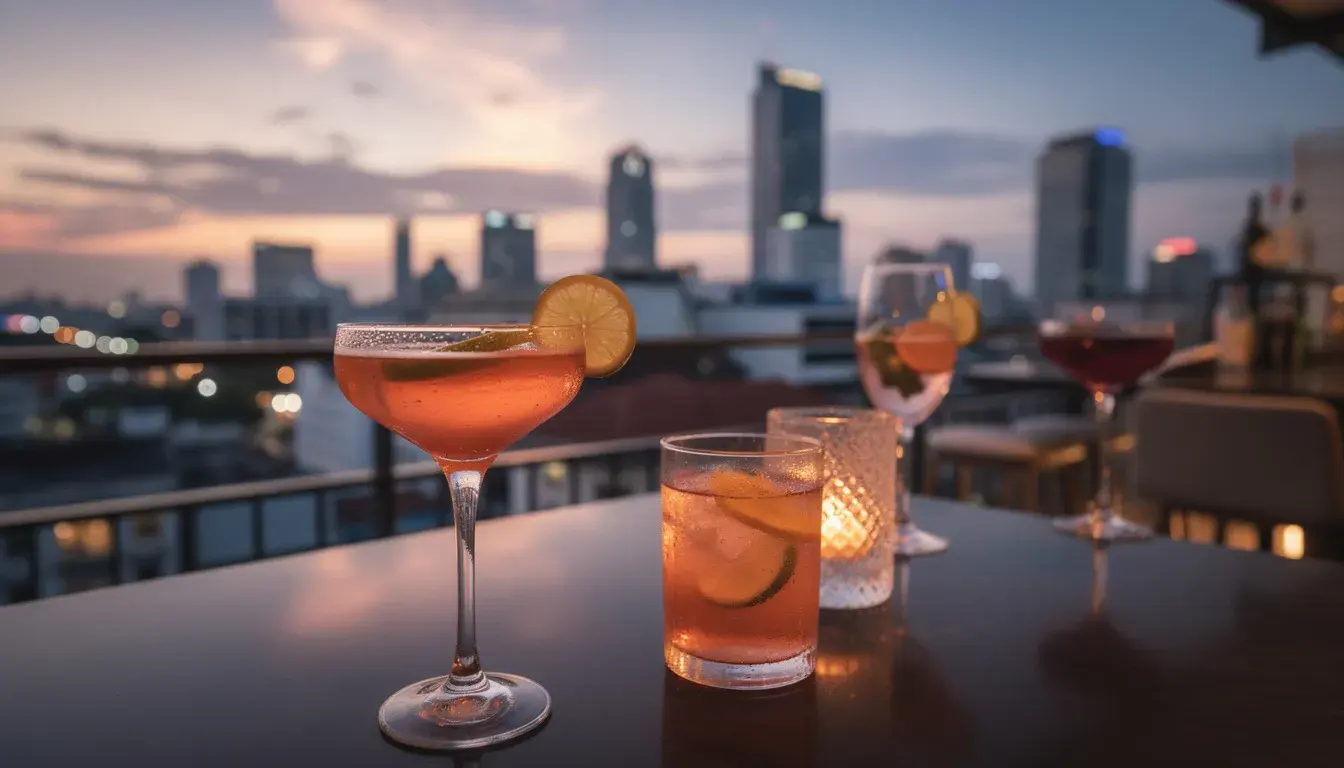
Rooftop bars give you a completely different perspective on Bangkok. From 60 floors up, you start to understand the city’s scale—endless towers stretching to the horizon, highways weaving through everything, and the Chao Phraya River snaking through the middle.
Popular rooftop options:
Venue | Location | Notes |
|---|---|---|
Sky Bar at Lebua | State Tower, ~63rd floor | Made famous by “The Hangover Part II,” strict dress code, iconic |
Octave Rooftop | Marriott Sukhumvit, 45th floor | Multi-level, great for sunset, more relaxed dress code |
Tichuca Rooftop Bar | Sukhumvit | Jungle theme, DJ nights, younger crowd |
Vertigo at Banyan Tree | Sathorn, 61st floor | Quieter, stunning views, minimum spend around 300 THB |
Timing tip: Arrive 45-60 minutes before sunset to secure a good spot, especially on weekends and holidays. You don’t need to spend the whole night—one drink is usually enough to enjoy the experience.
Chao Phraya River Evenings – Asiatique & Night Cruises
The Chao Phraya River offers a completely different kind of Bangkok evening—more relaxed, family-friendly, and surprisingly romantic if you catch the right light.
Asiatique The Riverfront is a popular open-air complex with:
Riverside promenade and Ferris wheel
Dozens of restaurants and souvenir shops
Free shuttle boat from Sathorn/Taksin pier
Best visited around sunset for strolling and dinner
Evening river cruises range from simple hop-on-hop-off tourist boats to dinner cruises with buffets and live music. The views of the Grand Palace and Wat Arun lit up at night are genuinely beautiful.
Warning: Street agents sometimes sell overpriced private longtail boat tours. Stick to official Chao Phraya Tourist Boat counters for fair prices.
This is a perfect low-effort evening after a hot sightseeing day, especially if you’re staying near the river in central Bangkok.
Markets, Malls & Neighborhoods You Shouldn’t Miss
Bangkok is as much about wandering markets and neighborhoods as it is about ticking off temples. The city has this incredible range—from chaotic open-air markets where you’ll sweat through your shirt to gleaming massive shopping malls with arctic air conditioning and fantastic restaurants.
Mix both into your trip. Spend a few hours at a market, then cool down in a mall. It’s how locals live, and it’ll save you from heat exhaustion.
Weekend timing matters: Chatuchak Market only runs Saturday and Sunday, and some floating markets are weekend-focused too. Try to align your visit with at least one Saturday or Sunday in the city.
Chatuchak Weekend Market – Massive Market Madness
Chatuchak is one of the world’s largest weekend markets. With over 8,000 stalls spread across 35 acres, it sells everything imaginable—clothes, vintage furniture, plants, Thai art, ceramics, pets, and more food stalls than you could try in a week.
Detail | Information |
|---|---|
Opening times | Saturday & Sunday, roughly 09:00–18:00 |
Some sections | Friday evening for night market vibes |
Nearest transport | BTS Mo Chit or MRT Chatuchak Park / Kamphaeng Phet |
Go early to avoid the crushing mid-day heat
Bring cash—many stalls don’t take cards
Wear comfortable shoes (you’ll walk miles)
Pick a meeting point if you’re with others—it’s easy to get separated
Bargain politely, but know that some newer shops have fixed prices
Taking the BTS or MRT avoids traffic that can make taxi rides painfully slow. The market connects directly to the transit stations.
Chinatown (Yaowarat) – Night Street Food & Neon Chaos
Yaowarat Road is one of the world’s biggest and most vibrant Chinatowns, and it’s best experienced after dark. This is where Bangkok’s street food scene reaches its peak—hundreds of stalls, blazing woks, and neon signs in Chinese and Thai competing for your attention.
How to do it:
Arrive around 18:00–19:00 as stalls set up
Start at the Chinatown Gate and walk slowly along Yaowarat
Duck into side alleys for quieter stalls and hidden gems
Use MRT Wat Mangkon station to avoid traffic—the station entrance has beautiful Chinese-style decorations
Must-try items:
Grilled seafood (prawns, squid, scallops)
Dim sum and Chinese noodles
Mango sticky rice from local vendors
Chinese-style desserts and bubble tea
Oyster omelets
Earlier in the afternoon, nearby Talat Noi is worth exploring for street art, old Sino-Portuguese shophouses, and hidden cafés—it feels like a completely different Bangkok.
Bangkok’s Shopping Malls – Cool Air & Food Courts
Shopping malls aren’t just for buying things in Bangkok—they’re a core part of local life. Locals use them for air conditioning, cheap food court meals, movies, and meeting friends. For travelers, they’re perfect mid-day escapes from the heat.
The Siam area cluster:
Siam Paragon – Luxury brands, Sea Life Bangkok aquarium, excellent food hall
MBK Center – Budget clothes, electronics, phone repairs, busy and chaotic
CentralWorld – Mid-range shopping, major events, huge central plaza
Other standouts:
Terminal 21 (Asok BTS) – Each floor themed after a different city (Tokyo, London, Rome), with an excellent and affordable food court called Pier 21
Iconsiam (on the river) – High-end shopping plus an indoor floating market-style food zone, rooftop views, free boat from Saphan Taksin pier
Use malls strategically as mid-day “cool-down” stops between outdoor sightseeing, especially during the hot season (March–May). A few hours in air conditioning makes the afternoon much more bearable.
Parks & Green Escapes – Lumpini & Benjakitti
When you need a break from crowded streets and traffic noise, Bangkok’s parks offer surprising calm.
Lumpini Park is Bangkok’s original central park:
Lakes with paddle boats
Jogging paths and outdoor gyms
Famous monitor lizards sunbathing by the water
Best early morning or late afternoon when temperatures drop
Benjakitti Forest Park is newer and more landscaped:
Elevated walkways over wetlands
Great skyline photo spots
Connects to Lumpini via a skywalk
You can stroll from one park to the other in a single outing, making it perfect for joggers, families, or anyone needing a few hours of peace.
Food & Drink In Bangkok – What (And Where) To Eat
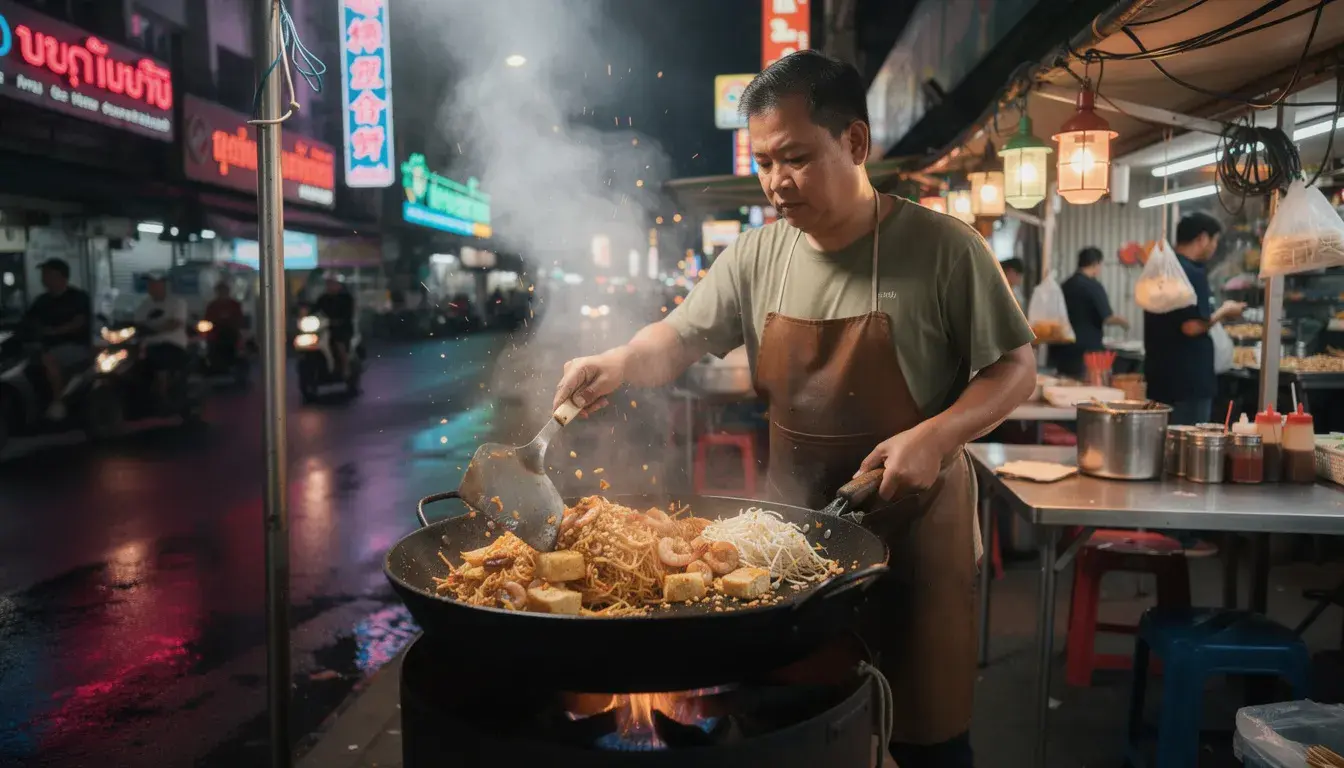
Bangkok is one of the world’s great food cities. This isn’t marketing speak—it’s a place where plastic stools on the sidewalk and street carts with ancient woks regularly produce better meals than fancy restaurants with white tablecloths.
The approach is simple: balance famous “foodie” spots with random neighborhood places that look busy with locals. If a stall has a line of Thai people waiting, get in it.
Most dishes cost under 100-150 Thai baht from street vendors, and English or picture menus are increasingly common in touristy areas. Having mobile data via an eSIM makes finding specific spots like Thipsamai or Rung Rueang Pork Noodles much easier—just pull up Google Maps and navigate.
Classic Dishes To Try In Bangkok
These are the traditional Thai dishes every first-timer should experience:
Dish | Description |
|---|---|
Pad Thai | Stir-fried rice noodles with tamarind, peanuts, and your choice of protein |
Tom Yum Goong | Hot and sour soup with prawns, lemongrass, and chilies |
Pad Kra Pao | Stir-fried holy basil with meat, served with rice and a fried egg |
Mango Sticky Rice | Sweet glutinous rice with fresh mango and coconut cream |
Som Tam | Spicy green papaya salad, often intensely hot |
Boat Noodles | Small bowls of rich, often blood-thickened noodle soup |
Thai Milk Tea | Sweet, creamy orange tea served iced |
For vegetarians/vegans: Many street spots use pork, fish sauce, and oyster sauce as base ingredients. Clearly say “no meat, no fish sauce” and consider researching veg-friendly areas like Ari or specific vegetarian restaurants in advance.
Practical notes:
Eat where turnover is high—busy stalls mean fresh food and better safety
Carry small bills (20s and 100s)—many food stalls don’t take cards
Don’t fill up at one spot—graze across multiple stalls
Specific Food Spots & Street Food Areas
These are some of the most recommended spots for authentic Thai food:
Thipsamai Pad Thai (Maha Chai Road)
Operating since 1939, serves 5,000 plates daily
Famous for best pad thai with giant prawns and tamarind sauce
Expect lines at peak hours—around 80 THB per plate
Rung Rueang Pork Noodles(near Asok)
Michelin Bib Gourmand since 2016
Pork noodle soup simmered for 12 hours—around 60 THB
Somsak Pu Ob (Talat Noi/Thonburi)
Clay-pot glass noodles with crab or shrimp
Waits can hit 1.5 hours for the legendary fermented crab paste broth
Around 150-300 THB depending on seafood
Pee Aor Tom Yum (near Ratchathewi/Sukhumvit)
Rich, intense tom yum packed with seafood
Praised by chefs including Gaggan Anand—around 100 THB
Yaowarat Night Market (Chinatown)
2km stretch with 300+ stalls
Grilled seafood, noodles, oyster omelets, durian
Peak crowds reach 100,000 visitors on busy nights
Iconsiam Indoor Floating Market
Air-conditioned food zone styled like traditional floating markets
Easy, English-friendly way to try many dishes in one place
Mix these destination spots with spontaneous finds in neighborhoods like Ari, Victory Monument, or around local BTS stops. Some of the best meals come from places you stumble upon.
Queue tip: Famous stalls have long lines at standard mealtimes. Going slightly before or after peak hours shortens waits significantly.
Bangkok’s Coffee Shops
Coffee: Look for cafés with river or skyline views—small coffee shops near Chinatown piers or in buildings like Empire Tower offer “viewpoints” at a fraction of rooftop bar prices. Thai iced coffee is strong, sweet, and addictive.
Important: Thailand has alcohol sale time restrictions—supermarkets and convenience stores like 7-Eleven can only sell alcohol from 11:00-14:00 and 17:00-midnight. This catches many travelers off-guard when trying to buy beer in the afternoon.
Relaxing & Recharging – Massages, Parks & Easy Days
Here’s something first-timers often miss: Bangkok will exhaust you. The heat, the humidity, the walking, the sensory overload—it all adds up. Planning downtime isn’t lazy; it’s smart.
A half-day by a hotel pool, a long massage, or an aimless wander through a park can make the rest of your trip more enjoyable. Schedule relaxation after big sightseeing days rather than packing every hour with activities.
Traditional Thai Massage & Spas
Traditional Thai massage is different from oil massage. It’s done fully clothed, involves stretching and acupressure along energy lines called “sen,” and feels more like assisted yoga than a spa treatment. You’ll be pushed, pulled, and twisted—and somehow leave feeling energized rather than sleepy.
Finding a massage:
Type | Typical Price | Where |
|---|---|---|
Simple massage shops | 200-400 THB/hour | Almost every busy street |
Mid-range chains (Health Land) | 300-500 THB/hour | Multiple locations, clean and consistent |
Bangkok spas (hotel level) | 1,000+ THB/hour | Silom, Sukhumvit, major hotels |
The difference in price reflects environment and extras (private rooms, saunas, aromatherapy) more than technique. Simple massage parlors can be just as skilled as fancy spas. |
Tips:
Check Google reviews (4.5+ stars) before trying somewhere new
Walk away from places that feel pushy or unclear about prices
A foot massage is a great gateway if full Thai massage sounds intimidating
Many travelers end up booking several massages during a short visit—they’re affordable, restorative, and the perfect recovery after long walking days through bustling markets and temple grounds.
Final Thoughts – Is Bangkok Worth Visiting?
Absolutely.
Bangkok can feel overwhelming on day one—the heat, the noise, the traffic, the sheer scale of it all. But it quickly becomes addictive. There’s something about the contrast between gold-covered temples and chaotic street food alleys, between rooftop sunsets and late-night markets, that gets under your skin.
For first-timers, the key is focusing on a handful of core areas rather than trying to see everything. Spend time in the Old Town around the Grand Palace and Wat Pho, explore the river city feel of the Chao Phraya, eat your way through Chinatown, and balance all that intensity with a rooftop cocktail or a Thai massage.
With the right basics covered—a good hotel location, working eSIM data from Roambit.io, comfortable shoes, and realistic daily plans—Bangkok becomes surprisingly easy to enjoy. You’ll still sweat, you’ll still get stuck in traffic, and you’ll probably eat something that makes your eyes water. But that’s part of it.
Even a short stay in Bangkok will leave strong memories. And if you’re like most visitors, you’ll leave already planning what neighborhoods to explore next time.
0 Comments
Leave a Comment